
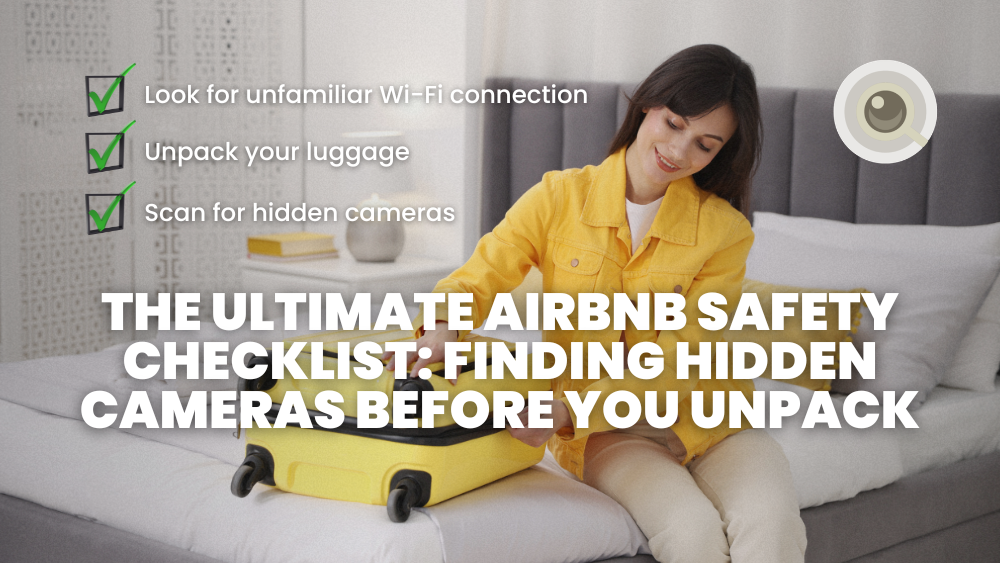
The Ultimate Airbnb Safety Checklist: Finding Hidden Cameras Before You Unpack
By: Admin
2026-05-19
Why This Matters More Than Most Travelers Realize
Staying in an Airbnb or vacation rental feels normal now. But what most travelers ignore is a growing privacy issue: hidden cameras in short-term rentals.
Reports across travel communities suggest that around 1 in 10 travelers has encountered suspicious recording devices or privacy violations during stays. Whether confirmed or not, the perception alone has changed traveler behavior.
And that shift is important for you as a traveler:
- People are no longer just checking cleanliness
- They are now checking for surveillance risks
- Privacy is becoming part of “basic travel hygiene”
Here’s the uncomfortable truth:
If you don’t actively check, you assume safety that may not exist.
This guide gives you a structured, practical system to inspect any Airbnb or vacation rental before you settle in and how to use modern detection tools like Detekcam to strengthen that process.
Step 1: Understand Where Hidden Cameras Are Actually Placed in Rentals
Airbnbs are different from hotels because they are designed like real homes, which makes detection harder.
Hosts (or bad actors) don’t install obvious surveillance devices. They rely on objects that blend naturally into domestic environments.
Most common hiding spots in vacation rentals:
1. Living room & common areas
- TV units
- Decorative shelves
- Wi-Fi routers
- Smart speakers
2. Bedrooms
- Alarm clocks
- Air purifiers
- Charging adapters
- Picture frames
3. Bathrooms (highest sensitivity zone)
- Exhaust fans
- Wall hooks
- Shelving units
- Toiletry holders
4. Entry points
- Doorbells
- Smoke detectors
- Wall-mounted decorations
Anything with power + facing a wide field of view is a potential risk point.
Step 2: The 5-Minute Entry Inspection
Before unpacking anything:
1. Stop and scan the room slowly
Don’t rush. Most people miss details because they immediately settle in.
Look for:
- Objects facing beds or showers
- Items placed unusually high or low
- Devices with no clear purpose
2. Check symmetry and alignment
Hidden devices often break visual consistency:
- Slightly tilted frames
- Objects pointing toward private areas
- “New-looking” electronics in old interiors
3. Inspect small holes or dark dots
Camera lenses require a line of sight. That means:
- Tiny pinholes matter
- Especially in smoke detectors or clocks
4. Check reflections
Turn off bright lights and move your phone flashlight slowly across surfaces. Lenses often reflect light differently than surrounding material.
Step 3: How Airbnb Hidden Cameras Differ From Hotel Cameras
This is where most guides fail—they treat all locations the same.
Airbnb environments are:
- More personalized
- Less standardized
- More likely to include “normal-looking” electronics
Key difference:
- Hotels use industrial surveillance systems.
- Airbnbs often rely on consumer-grade disguised devices.
That means:
- More diversity in hiding methods
- Less predictable placement
- Higher chance of object-based concealment
So your approach must be more observational, not just technical.
Step 4: Using Technology to Support Detection (Not Replace It)
Here’s what it can actually do:
1. Lens reflection scanning
Use your phone camera and flashlight to scan reflective surfaces. Look for unnatural light points.
2. Network awareness
Some devices may appear as unknown connections if they are online.
But many modern hidden cameras:
- Operate offline
- Record locally
- Or use encrypted networks
So absence of signals does NOT mean safety.
3. Infrared detection
Some older devices emit infrared light invisible to the human eye but visible through phone cameras.
Limitation: Most modern devices minimize IR emission.
Step 5: Where Most Travelers Fail
Most users assume:
“If my phone doesn’t detect anything, I’m safe.”
That assumption is incorrect.
Here’s why detection fails:
- Passive recording devices emit no signals
- Wired cameras are invisible to Wi-Fi scans
- Objects are designed to avoid suspicion entirely
- Lighting conditions affect reflection detection
So relying only on a phone creates false confidence, not security.
Step 6: How DETEKCAM Changes the Process
This is where structured detection becomes important.
Unlike basic phone-based checks, DETEKCAM is designed for:
- Faster environmental scanning
- Better identification of concealed electronic devices
- Reduced dependency on guesswork
- More consistent detection in low-light or complex interiors
In a real Airbnb scenario, the workflow becomes:
- Enter room
- Run full scan with Detekcam
- Mark suspicious zones
- Cross-check physically
- Decide whether to continue stay
This removes the “blind uncertainty” phase most travelers operate in.
Step 7: What to Do If You Suspect a Hidden Camera
If something feels off, don’t escalate emotionally.
- Do not confront immediately — You may be wrong and confrontation can create unnecessary conflict.
- Document everything — Take photos, record location of suspicious objects, note time and context.
- Leave sensitive spaces first — If suspicion is in a bedroom or bathroom, prioritize exiting that space.
- Report through proper channels — Airbnb support system, local authorities if necessary.
- Do not continue the stay if risk feels real — Your comfort is not negotiable in this situation.
Step 8: Airbnb Safety Checklist
Before unpacking:
- Scan room visually before settling
- Check smoke detectors & vents
- Inspect clocks, frames, chargers
- Look for unusual reflections
- Check bathroom fixtures carefully
- Scan network/device signals (optional)
- Run detection tool (Detekcam recommended)
- Trust instinct if something feels off
Safety Is Not Paranoia, It’s Process
The biggest mistake travelers make is treating safety as emotional:
- “I feel fine, so I’m fine”
- “This looks normal, so it is normal”
That mindset doesn’t work in short-term rentals anymore.
Modern privacy safety is:
- Structured
- Repeatable
- Tool-supported
- Not intuition-based
And that’s exactly where dedicated detection solutions like DETEKCAM fit—not as paranoia tools, but as pre-stay verification systems.
Copyright © 2024 Cybergram Pte Ltd (UEN: 202300863E) t/a DETEKCAM
